
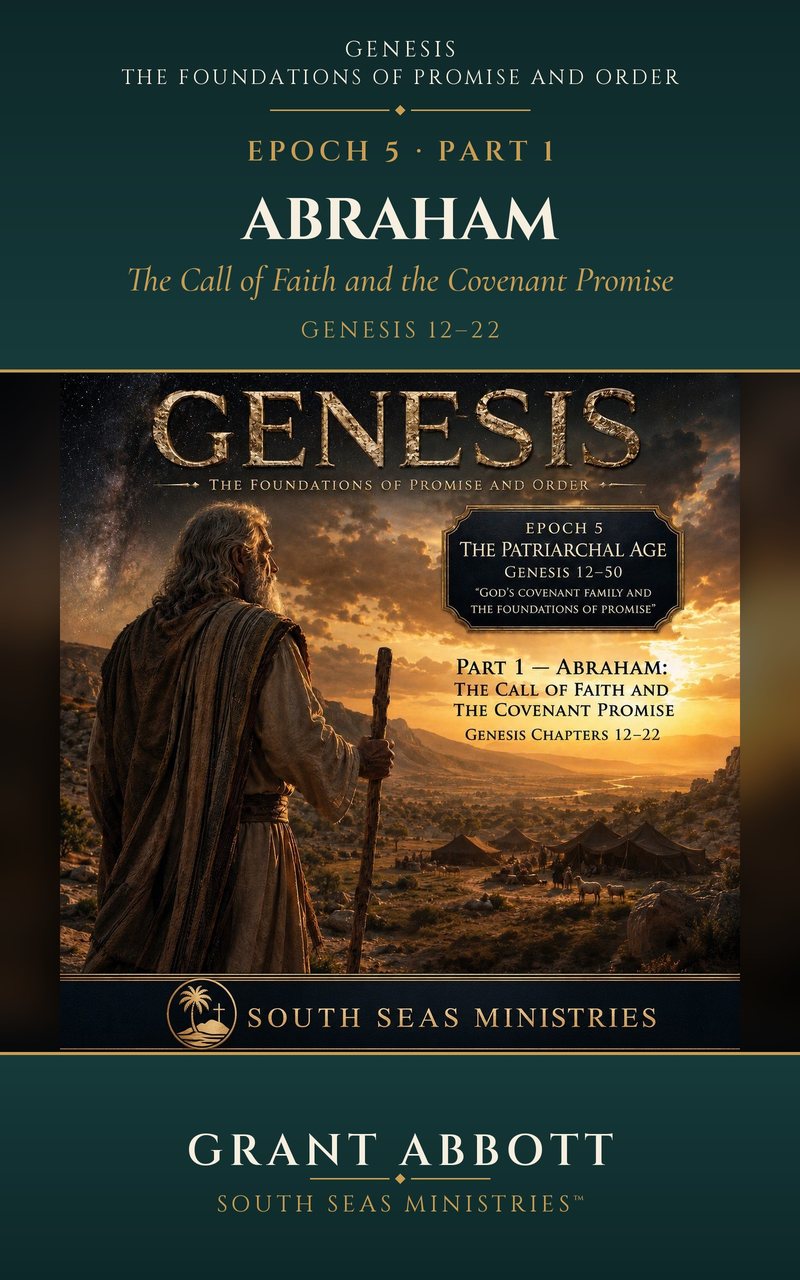
Author: Grant Abbott
Publisher: South Seas Ministries™
© 2023–2026 Grant Abbott, author. Published by South Seas Ministries™. All rights reserved.
All content in this story—including text, images, and other media—is the work of Grant Abbott, published by South Seas Ministries™.
Unauthorized reproduction, distribution, or publication of any portion of this material without prior written consent is not permitted.
This story is provided for personal study, spiritual growth, and educational use within the context of your faith journey.
Commercial use of this material is not allowed without explicit authorization.
Scripture taken from the New King James Version®. Copyright © 1982 by Thomas Nelson. Used by permission. All rights reserved.
Scripture is quoted within Thomas Nelson’s published guidelines for quoting the NKJV without written permission.
For ministry-related permissions or inquiries, please contact: South.Seas.Ministries@outlook.com
For personal correspondence or author-related questions, reach out to: Grant.Abbott2@outlook.com
When referencing or excerpting this story, please attribute authorship to: Grant Abbott, author. Published by South Seas Ministries™.
This work is dedicated to the glory of God and the building up of His people.
Free Preview
Genesis Epoch 5 Part 1: Abraham — The Call of Faith and the Covenant Promise
Genesis 12–22
Introduction
Following the creation of the heavens and the earth, the entrance of sin through humanity's rebellion, the judgment of the Flood, and the division of the nations at Babel, the opening chapters of Genesis have revealed the continuing struggle between humanity's desire for independence and God's unwavering purpose to redeem His creation. Though mankind repeatedly turned away from the Lord, God remained faithful to His promises and continued working according to His perfect wisdom. The scattering of the nations did not mark the end of His plan; rather, it prepared the way for a new chapter in His unfolding work. From among the peoples of the earth, God would call one man and establish through him a covenant family through whom His blessing would eventually extend to all nations.
Genesis 12 introduces a dramatic shift in the biblical narrative as the focus moves from the history of humanity as a whole to the history of a specific family chosen by God. Abram, later named Abraham, was called to leave his homeland, his relatives, and the security of what he had known, trusting in the promise of the God who had revealed Himself to him. Through this calling, God established the foundation of the covenant promises that would shape the remainder of Scripture: a promised land, a multitude of descendants, and a blessing that would reach beyond Abraham's own family to every nation of the earth. This covenant was not based upon Abraham's greatness, wisdom, or strength, but upon the faithfulness of God, who had determined to accomplish His purposes through the family He would establish.
The lives of Abraham, Isaac, Jacob, and Joseph reveal the continuing work of God through generations of imperfect people who were sustained by His grace and guided by His providence. Abraham's faith was tested through uncertainty, waiting, and obedience. Isaac carried forward the covenant promise despite living in the shadow of his father. Jacob experienced God's transforming work as he moved from a life marked by self-reliance and deception toward becoming Israel, the father of the twelve tribes. Joseph's journey from betrayal and suffering to authority in Egypt demonstrated that God's purposes cannot be defeated by human sin or circumstances. Through each patriarch, Genesis reveals that the Lord faithfully preserves His promises even when His servants struggle to understand His timing or His methods.
The Patriarchal Age establishes the foundation for the covenant people of God and provides the framework for understanding the remainder of the biblical story. Through these generations, the Lord formed a family that would become the nation of Israel, through whom His revealed Word would be preserved and through whom His ultimate promise of redemption would come. The covenant promises given to Abraham find their ultimate fulfillment in Jesus Christ, the promised Seed through whom God's blessing reaches the nations. As we enter Genesis 12–50, we witness not merely the stories of individual families and historical events, but the faithful unfolding of God's eternal plan to restore what was lost, reveal His glory, and bring salvation according to His perfect purpose.
Historical and Cultural Background
The world of the patriarchs was shaped by the civilizations, peoples, and landscapes of the ancient Near East, a region that stretched from Mesopotamia through the land of Canaan and down into Egypt. Genesis 12 begins with Abram living in Ur of the Chaldeans, a significant city within the ancient world known for its wealth, trade, and advanced culture. From this environment, God called Abram to leave behind the security of his homeland and journey toward a land that the Lord would reveal to him. This movement from Mesopotamia to Canaan placed Abraham and his descendants within a world of traveling clans, city-states, agricultural communities, and established trade routes. The land of Canaan served as a crossroads between major civilizations, making it both strategically important and culturally diverse. Throughout the patriarchal narratives, locations such as Shechem, Bethel, Hebron, Beersheba, and the regions surrounding Egypt provide the historical setting where God's covenant promises unfolded. These places were not merely locations on a map; they became the settings where God revealed His faithfulness and established His purposes through generations.
The society of the patriarchs was built around the household, the extended family, and the larger clan structure. In this world, family identity, inheritance, and descendants were central concerns because a person's name and legacy were carried forward through future generations. The patriarch served as the head of the household, responsible for leading, protecting, and providing for those under his care.
Wealth was often measured through livestock, servants, land, and family strength, making God's promise of descendants especially significant to Abraham, Isaac, and Jacob. The repeated emphasis on offspring throughout Genesis reflects the importance of God's covenant promise within the cultural setting of the ancient world. For Abraham, who was called to become the father of a great nation while remaining childless for many years, the promise of descendants required genuine faith in God's ability to accomplish what He had spoken. The struggles surrounding barrenness, inheritance, and family relationships throughout Genesis reveal both the realities of ancient society and the deeper truth that God's purposes are fulfilled according to His timing rather than human ability.
Many customs and practices described in Genesis become clearer when viewed within their historical context. Hospitality was a deeply valued responsibility in the ancient Near East, particularly among traveling peoples who depended upon the generosity and protection of others during their journeys. This cultural setting helps illuminate Abraham's welcoming of visitors, the importance of covenant meals, and the relationships formed through agreements between households and leaders. Marriage arrangements, burial customs, land transactions, and the transfer of blessings were also significant aspects of patriarchal life. The purchase of the field and cave at Machpelah, the search for Isaac's wife, Jacob's household relationships, and Joseph's position within Egypt all reflect real practices and social structures of the ancient world. These details demonstrate that Genesis presents the patriarchs within a genuine historical setting, where ordinary matters of family, property, and survival existed alongside God's extraordinary work through His covenant promises.
Above all, the historical and cultural setting of the Patriarchal Age reveals the remarkable faithfulness of God as He worked through one family to accomplish His greater redemptive purpose. The surrounding nations had their own rulers, customs, and religious systems, but Genesis consistently presents the Lord as the sovereign Creator who governs peoples, places, and events according to His will. The patriarchs lived among cultures that worshiped many gods, yet their stories reveal the unfolding revelation of the one true God who calls, promises, and preserves. Through Abraham, Isaac, Jacob, and Joseph, God established the foundation of Israel's identity and prepared the way for the fulfillment of His covenant promises. The historical events of Genesis 12–50 are not isolated family accounts; they are the beginning of the covenant story that leads to the formation of Israel, the preservation of God's Word, and ultimately the coming of Jesus Christ, through whom the blessing promised to Abraham would extend to all nations.
Author and Audience
The Book of Genesis was written by Moses under the inspiration of the Holy Spirit as the foundational record of God's work from creation through the formation of the covenant family of Israel. Continuing the unified story established throughout the previous epochs, Moses records how the Lord created all things, how sin entered the world, how judgment came through the Flood, how nations were divided, and how God began His covenant work through Abraham and his descendants. In Genesis 12–50, Moses preserves the history of the patriarchs to reveal the faithfulness of God in establishing His promises through generations. Through the lives of Abraham, Isaac, Jacob, and Joseph, Moses demonstrates that the Lord is not only the Creator of all humanity but also the God who calls, guides, disciplines, preserves, and fulfills His covenant purposes according to His perfect will. These accounts were given not merely as historical records of individuals, but as a revelation of God's unfolding plan to bring blessing to the nations through the family He had chosen.
The original audience of Genesis was the nation of Israel, the descendants of the very patriarchs whose lives Moses recorded. As Israel journeyed through the wilderness toward the land God had promised, they needed to understand who they were, where they came from, and why they belonged to the Lord. The stories of Abraham, Isaac, Jacob, and Joseph provided the foundation for their identity as God's covenant people. They learned that their relationship with God was not based upon their own greatness or accomplishments, but upon the promises He had made to their fathers. The accounts of God's faithfulness through generations of uncertainty, hardship, and human weakness would encourage Israel to trust the same God who had guided Abraham from his homeland, preserved Jacob's family, and used Joseph to save them during famine. Genesis reminded them that the Lord who established His covenant in the past remained faithful to lead them into the future.
For believers today, the patriarchal narratives continue to reveal the character and faithfulness of God and call us to trust His promises. The lives of Abraham, Isaac, Jacob, and Joseph demonstrate that faith is not the absence of struggle but the confidence that God remains faithful in the midst of uncertainty, waiting, and hardship. Their stories remind us that God works through imperfect people while accomplishing His perfect purposes, and that His plans cannot be hindered by human weakness or circumstances. Through the fulfillment of the covenant promises in Jesus Christ, believers today see the greater purpose behind God's work through the patriarchs and understand that all who place their faith in Christ are brought into the blessing promised through Abraham's Seed.
Genesis 12–50 continues to speak to His people by revealing a faithful God who calls, transforms, preserves, and completes the work He begins.
After the scattering of the nations at Babel, Genesis now narrows its focus to the calling of one man through whom God would begin revealing His covenant purposes. Abram's story begins not with human initiative but with the sovereign call of God, who chose him and promised that through his descendants all the families of the earth would be blessed. Leaving behind his homeland and the security of what he had known, Abram would begin a journey of faith marked by both obedience and dependence upon the promises of the Lord. Through Abraham's life, God would establish the foundation of His covenant family, demonstrating His faithfulness through seasons of uncertainty, testing, and waiting. The chapters that follow reveal the God who calls, guides, transforms, and preserves His people, preparing the way for the fulfillment of His promises through the coming Redeemer.
The story itself, with its conclusion, reflection and application, continues in the complete book.
Closing Prayer
Heavenly Father,
We come before You with thankful hearts, honoring You as the everlasting God who calls, sustains, and faithfully completes every purpose according to Your perfect wisdom. You are the God who established promises before generations had seen their fulfillment, who guides history with patience, and who remains faithful when circumstances appear uncertain. Nothing is hidden from Your sight, and no promise spoken by Your mouth can ever fail. You formed Abraham’s journey with purpose, leading him through seasons of waiting, correction, provision, and blessing. We praise You because Your faithfulness does not depend upon human strength, understanding, or ability. Your mercy remains constant, Your wisdom remains perfect, and Your love continues through every generation.
May our hearts always recognize Your greatness and respond with gratitude, reverence, and joyful trust.
We thank You for the testimony of Abraham’s journey and the covenant faithfulness You revealed through every season of his life. Through his calling, his waiting, his struggles, and his obedience, You demonstrated that Your purposes remain secure even when the path ahead is unclear. You taught Abraham that Your promises are fulfilled according to Your timing and that Your wisdom surpasses every human expectation. We are grateful that You are patient with those You are forming, correcting hearts while continuing to accomplish Your purposes. Through the promise of Isaac and the events surrounding Mount Moriah, You revealed that You are the God who provides, the God who sees, and the God who remains faithful to Your word. May this testimony strengthen our confidence in Your character and encourage us to walk faithfully before You.
Lord, we give thanks for Jesus Christ, the promised Savior through whom Your covenant blessings extend to all nations. In Him, we see the fullness of Your redemptive plan revealed, the perfect fulfillment of every promise, and the assurance of salvation offered through Your grace. The provision revealed through Abraham’s journey points us toward the greater provision accomplished through the sacrifice of Your Son, who willingly gave Himself so that we might be reconciled to You. We praise You for the love displayed through Christ, for the forgiveness He provides, and for the hope that rests securely in Him. We also thank You for the Holy Spirit, who opens our understanding, strengthens our faith, and guides us into Your truth as we walk with You daily.
Lord Jesus, we honor You as the faithful Son who accomplished the Father’s will with perfect obedience, humility, and love. You are our Redeemer, our hope, and our foundation through every season of life. We thank You that through Your sacrifice we are brought near, and through Your resurrection we have the assurance of eternal life. Holy Spirit, we thank You for Your continuing work within us, shaping hearts that reflect the character of Christ and teaching us to trust the Father’s wisdom. Strengthen us when faith is tested, comfort us when uncertainty surrounds us, and lead us into greater obedience and dependence upon God. May Your presence produce lives marked by faithfulness, humility, and gratitude as we follow where You lead.
Father, we lift our families before You with thanksgiving, asking that homes would be filled with peace, patience, and love that reflects Your goodness. Strengthen marriages with commitment, kindness, and understanding, and guide parents as they nurture children with wisdom, compassion, and faithfulness. May households become places where truth is valued, forgiveness is practiced, and encouragement is freely given. Help families recognize that every relationship is sustained by Your grace and that every generation is an opportunity to display Your faithfulness. Bring healing where there is division, restoration where there has been distance, and renewed joy where burdens have become heavy. May homes reflect the beauty of Your love and become places where Your goodness is remembered and shared.
Father God, we pray for Your Church throughout the world, asking that believers would remain faithful to Your Word and devoted to the calling You have given. Strengthen pastors, teachers, and leaders with wisdom, humility, and compassion as they serve Your people. Unite the Church in truth, love, and purpose, that her witness would remain clear in every generation. May worship be sincere, service be joyful, and fellowship be marked by grace and encouragement. Equip every believer to live faithfully, carrying the hope of Christ into their communities. Let Your Church reflect the light of Your kingdom, proclaiming Your truth with courage while extending Your mercy with compassion.
Dear Lord, we lift the nations and communities of the world before You, asking that Your goodness would be recognized among all peoples. Stir hearts toward compassion, justice, and peace, especially where suffering, conflict, and uncertainty remain. Give wisdom to those who serve others, strengthen those who provide care, and open opportunities for acts of kindness that reflect Your love. May those searching for hope encounter the grace of Christ through the lives and actions of Your people. Guide communities toward understanding, generosity, and reconciliation. Let compassion increase across every land, and may Your purposes continue advancing as people respond to Your truth with humility and faith.
Father, we place leaders and authorities before You, asking for wisdom, integrity, and discernment in every nation. Guide those entrusted with responsibility to pursue justice, protect the vulnerable, and serve with humility. May decisions be shaped by righteousness, understanding, and a sincere desire for the good of those under their care. Bring peace where conflict exists, clarity where confusion remains, and stability where uncertainty has taken hold. Above all, may hearts throughout the earth be turned toward what is good, what is honorable, and what reflects Your perfect purposes. We surrender all things into Your hands, trusting that You remain sovereign every generation and every circumstance.
May all we do reflect Your grace, and bring to You honor, glory, and praise.
In the name of Jesus Christ, we pray.
Amen.
The Complete Book
The complete book is available now as an ebook for $5.99 on Amazon Kindle. It is also available in paperback for $10.49 on Amazon. You can also find it at Apple Books, Barnes & Noble, Kobo and other stores. Search for Genesis Epoch 5 Part 1: Abraham — The Call of Faith and the Covenant Promise by Grant Abbott, or use the buttons below.
Buy on Amazon Kindle · $5.99 Paperback · $10.49 on Amazon More stores: Kobo and others All the books