
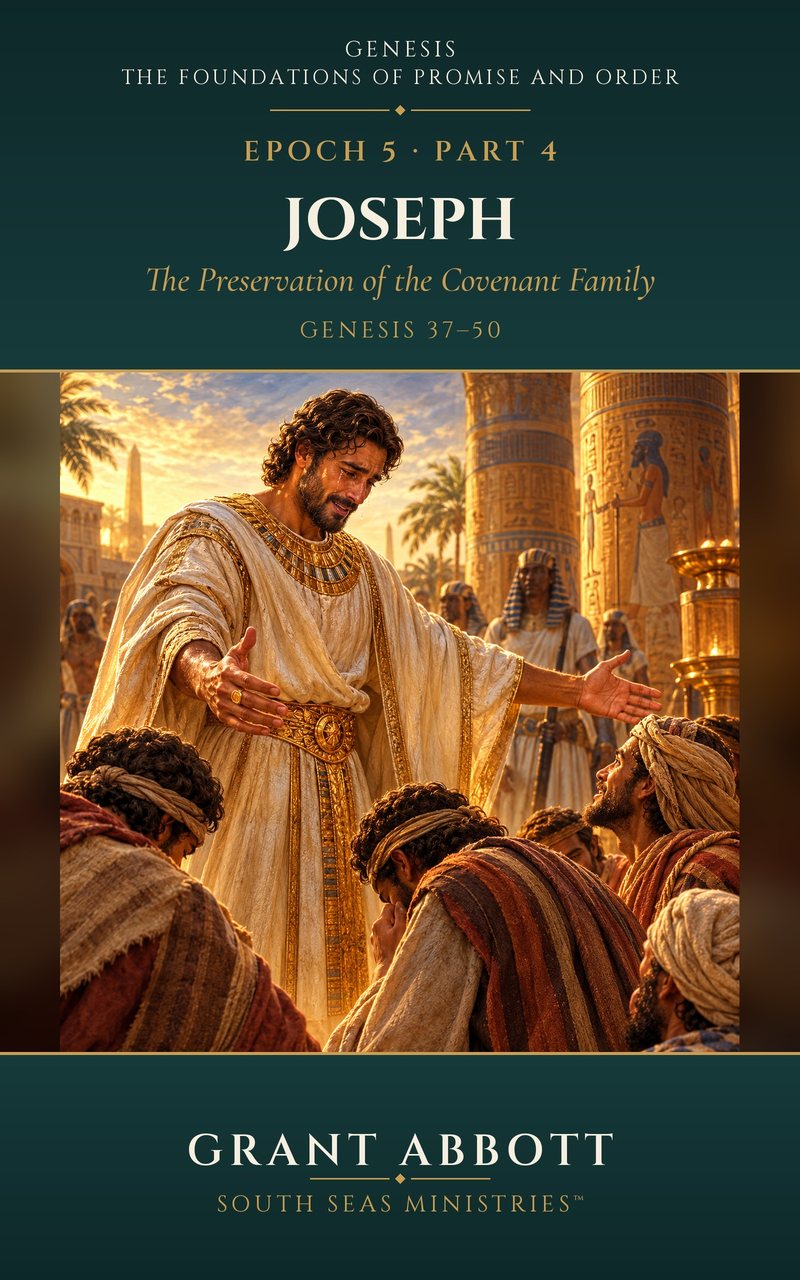
Author: Grant Abbott
Publisher: South Seas Ministries™
© 2023–2026 Grant Abbott, author. Published by South Seas Ministries™. All rights reserved.
All content in this story—including text, images, and other media—is the work of Grant Abbott, published by South Seas Ministries™.
Unauthorized reproduction, distribution, or publication of any portion of this material without prior written consent is not permitted.
This story is provided for personal study, spiritual growth, and educational use within the context of your faith journey.
Commercial use of this material is not allowed without explicit authorization.
Scripture taken from the New King James Version®. Copyright © 1982 by Thomas Nelson. Used by permission. All rights reserved.
Scripture is quoted within Thomas Nelson’s published guidelines for quoting the NKJV without written permission.
For ministry-related permissions or inquiries, please contact: South.Seas.Ministries@outlook.com
For personal correspondence or author-related questions, reach out to: Grant.Abbott2@outlook.com
When referencing or excerpting this story, please attribute authorship to: Grant Abbott, author. Published by South Seas Ministries™.
This work is dedicated to the glory of God and the building up of His people.
Free Preview
Genesis Epoch 5 Part 4: Joseph and the Preservation of the Covenant Family
Genesis 37–50
Introduction
Seventeen years old and already dreaming of sheaves that bow and stars that bend low, Joseph steps into the biblical record as the son who will carry his father's covenant hope into a foreign land. Genesis 37 through 50 forms the final movement of the book of beginnings, closing out the patriarchal narratives with a story unlike any that came before it. Abraham heard promises spoken over open sky and starlit desert. Isaac inherited those promises through quiet faithfulness. Jacob wrestled with God and man until his name itself was changed. Joseph's chapters carry a different texture entirely, unfolding across two decades of betrayal, slavery, false accusation, imprisonment, and eventual exaltation, all set against the political machinery of Egypt rather than the open pastures of Canaan. Yet the covenant thread never breaks. What begins with a father's favoritism and a coat of many colors ends with an entire family transplanted to Goshen, preserved through famine, and gathered around a dying patriarch's final words of blessing. Sound exposition has long recognized this closing section of Genesis as one of Scripture's clearest studies in divine providence, the doctrine that God works through ordinary circumstances, human choices, and even human sin to accomplish His sovereign purposes without ever violating human responsibility. Joseph himself names this truth plainly near the story's end, telling his brothers that what they intended for evil, God intended for good. That single sentence supplies the interpretive key for everything that unfolds across these fourteen chapters.
Reading these chapters well requires setting aside modern assumptions about family favoritism and ancient assumptions about fate. Nothing in Joseph's story happens because the stars aligned or because misfortune simply ran its course. Every reversal, every delay, every seemingly random encounter with a passing caravan or a forgotten cellmate serves a larger design that Joseph could not see while he was living it. This is precisely why the account matters so much for our own walk with Christ. We rarely receive explanations in the moment of our suffering. Joseph spent thirteen years between the pit and the palace without a single recorded word from heaven clarifying his circumstances, and still the narrative insists that the Lord was with him throughout the darkest stretches of that journey. This account is treated as historical fact rather than moral fable, a real family whose real dysfunction became the very instrument through which God preserved the seventy souls who would become the nation of Israel. The famine that drives the brothers to Egypt, the recognition scene that breaks Joseph's composure, the tearful reunion with Jacob, and the patriarch's dying blessings over his twelve sons all belong to a single sustained argument: the God who called Abraham out of Ur keeps every promise He makes, using whatever means He chooses, including the very evil that men intend against one another.
Understanding this from the outset shapes how we read every scene that follows, from the pit at Dothan to the granaries of Egypt to the deathbed in Goshen, where this long story finally comes to rest.
Joseph occupies a unique position among the patriarchs because Scripture records no sin on his part, no deception like his father's, no rash violence like his brothers Simeon and Levi, no compromise with pagan neighbors like Judah's episode with Tamar interrupting his own account. He forgives rather than retaliates, resists temptation rather than yielding to it, and administers Egypt's resources with integrity rather than self-interest even while holding near-absolute power over the very men who sold him. Many students of Scripture have noted the pattern that runs through his life: a beloved son sent by his father, rejected by his own people, sold for silver, falsely accused, numbered among criminals, and afterward exalted to the highest seat of authority, from which he becomes the means of saving both his own family and the surrounding nations from starvation. This pattern is drawn out here without forcing artificial correspondences, recognizing Joseph as one of Scripture's clearest Old Testament pictures anticipating the greater Redeemer to come. Jesus, whose own brothers according to the flesh did not receive Him, was likewise handed over by those closest to Him, endured false accusation, and was raised to the highest place of authority, from which He now supplies bread that truly satisfies to a world facing its own famine of the soul. These parallels are noted where the text itself invites them and are never imposed as an artificial grid laid over the narrative, for Joseph remains first and always a historical man whose life God ordained for Israel's preservation.
Threaded through the whole account is the sober reality of family brokenness. Jacob's household was never a picture of harmony, and these closing chapters of Genesis do not soften that fact for the sake of a tidier narrative. Favoritism divided the brothers long before the coat was ever given. Old resentments over Leah and Rachel, over birthright and blessing, over years of unequal affection, simmer beneath the surface until they erupt into a plot to murder a seventeen-year-old boy. Judah's own moral failure occupies an entire chapter in the middle of Joseph's story, a placement that is neither accidental nor merely chronological, but that shows us the depth of the family's need for the very redemption God is quietly engineering. And yet this same fractured family becomes the vessel through which the twelve tribes of Israel are established, the family line preserved that will one day produce the Messiah promised all the way back to the garden. We find here neither an idealized portrait of patriarchal piety nor a cynical account of human failure, but something far more useful for our own households: a truthful picture of God's covenant faithfulness operating through, not around, real sin and real reconciliation.
Genesis 37 through 50 asks us to trust the character of God even when family relationships remain unresolved for years, and even when His purposes stay hidden until long after the pain has done its worst. Every family carrying its own unspoken histories of favoritism, rivalry, and unaddressed offense will find itself somewhere within these fourteen chapters, and every such family is invited into the same hope Joseph's brothers eventually received: forgiveness offered freely by the one they wronged.
Historical and Cultural Background
Canaan in the patriarchal period was a land of shepherds and small clan settlements, its economy built around flocks, seasonal grazing, and the fragile margins of rain-fed agriculture. A single bad harvest could threaten an entire household's survival, which explains why famine drives so much of the movement in Genesis, from Abraham's early flight to Egypt through Isaac's dealings with the Philistines to the crisis that eventually sends Jacob's sons south for grain. Egypt, by contrast, depended on the predictable annual flooding of the Nile rather than unreliable rainfall, giving it a level of agricultural stability that made it the ancient world's natural refuge whenever surrounding regions suffered drought.
This geographic reality forms the backdrop for Joseph's entire career. A slave boy from the Canaanite hill country would have entered a civilization already ancient by his own family's standards, with a centralized bureaucracy, a professional priesthood, monumental architecture, and administrative systems for grain storage and taxation far beyond anything his father's household had ever organized.
Egyptian records from this general era describe officials known as viziers who managed royal estates and oversaw agricultural policy, a role that offers a plausible historical parallel to the authority Pharaoh grants Joseph over the nation's food supply. Egypt's cultural distance from Canaan was not only geographic but religious, since its people worshiped a vast pantheon tied to the Nile, the sun, and the ruling dynasty itself, making Joseph's steadfast confession of the one true God all the more striking against his surroundings.
Trade routes connecting Canaan to Egypt ran through the Sinai corridor and were traveled regularly by caravans carrying spices, resin, and myrrh, exactly the kind of Ishmaelite and Midianite merchant company that purchases Joseph from his brothers at Dothan. Slavery in this world was a well-established commercial reality rather than an unusual crime, and a young man sold to traveling traders could expect to be resold in Egypt as household or agricultural labor with no legal recourse and no realistic hope of return. Egyptian households of standing, particularly those connected to the royal court, commonly held foreign slaves in domestic service, which is precisely the position Joseph occupies under Potiphar, a captain of the guard whose title indicates close proximity to Pharaoh himself. The narrative's later details about Joseph's imprisonment, his interpretation of dreams involving a cupbearer and a baker, and his eventual promotion to oversee Egypt's grain administration all fit comfortably within what we know of Egyptian court structure during this broad period, lending the account a texture of lived historical reality rather than a stylized legend. Even small details, such as Joseph shaving before appearing before Pharaoh, are consistent with what we know of Egyptian custom, since Egyptians generally considered facial hair unclean in a way that Semitic peoples did not. Such details matter because they anchor Joseph's story firmly within verifiable ancient custom rather than leaving it as a detached moral illustration untethered from time and place.
Family structure among the patriarchs granted the firstborn a position of double inheritance and covenant leadership, a custom that makes Jacob's open favoritism toward Joseph, the firstborn of his beloved Rachel rather than his firstborn overall, a genuine social provocation to his older sons. The distinctive garment Jacob gives Joseph, traditionally rendered a coat of many colors, likely signaled a status above ordinary labor, marking Joseph as set apart from the shepherding duties his brothers still performed daily in the field. Shepherding itself carried low social standing in Egyptian eyes, which explains why Joseph later instructs his brothers to identify themselves specifically as keepers of livestock when meeting Pharaoh, a detail that secures for them the pastoral region of Goshen precisely because Egyptians preferred to keep such foreigners at a comfortable distance from the capital.
Goshen's location in the eastern Nile Delta offered fertile grazing land while remaining separate enough from Egyptian population centers to allow Jacob's family to maintain its distinct identity across the following centuries, a geographic providence that would matter enormously once a later Pharaoh who did not know Joseph began to view this same family with suspicion rather than gratitude. That later shift lies beyond Genesis itself, but its seeds are planted here in the quiet separateness Goshen provided this covenant household for generations. Understanding this social arrangement helps explain why Jacob's descendants could grow into a distinct people numbering into the hundreds of thousands without dissolving into the surrounding Egyptian population.
Dream interpretation held enormous cultural weight in the ancient Near East, and Egypt in particular developed a class of professional interpreters and magicians attached to the royal court, the very officials who fail Pharaoh so completely when his dreams of lean and fat cattle demand an answer no natural wisdom can supply. Joseph's insistence, both before Pharaoh and earlier before his fellow prisoners, that interpretations belong to God rather than to human skill or occult technique, sets him apart sharply from every other dream reader in the Egyptian record and identifies him publicly as a servant of the God of his fathers even while serving in a foreign court. The famine itself, described as severe throughout all lands, matches what we know of periodic multi-year droughts capable of disrupting agriculture across the wider Near East, since Egypt's Nile-based system, while more stable than rain-fed Canaan, still depended on adequate flood levels that could fail for extended stretches.
Seven years of surplus followed by seven years of scarcity was not outside the range of plausible ancient climate patterns, and Joseph's proposed solution, storing a portion of each surplus harvest under centralized administration, reflects sound agricultural policy that Egyptian sources confirm was practiced in various forms throughout the kingdom's long history. Set against this backdrop, Joseph's counsel to Pharaoh appears not as an isolated stroke of genius but as wisdom given by God and expressed through governance any careful administrator of the period could recognize and implement.
Author and Audience
Moses stands behind the composition of Genesis as its human author, writing under divine inspiration during Israel's wilderness generation and recording with complete accuracy the covenant history God had given and preserved concerning Jacob's household, carrying that account forward to the exodus community Moses himself led. A generation freshly delivered from four hundred years of Egyptian bondage would have heard the Joseph narrative with an immediacy entirely different from ours, recognizing in his story the very explanation for how their ancestors came to reside in Egypt at all, and finding in his unwavering trust a pattern for their own uncertain wilderness journey toward a promised inheritance they had likewise not yet seen. Genesis as a whole closes the book of beginnings by tracing covenant history from creation through the patriarchs, and the Joseph narrative supplies its necessary bridge to Exodus, explaining exactly why a family of seventy shepherds from Canaan would later be found enslaved under a Pharaoh who no longer remembered the favor Joseph had once secured for his people. Without these fourteen chapters, the opening verses of Exodus would read as an unexplained tragedy rather than the outworking of a covenant God had been quietly preserving through famine, migration, and the slow multiplication of a single family into a nation numerous enough to alarm the ruling power of its day. Moses wrote as one who had personally inherited both the promises given to Joseph's fathers and the burden of leading Joseph's descendants toward their fulfillment, giving his account of these events a weight that no detached historian could have supplied.
Israel's first audience needed more than genealogy from this account; they needed assurance that the God who had rescued them from Pharaoh's grip was the same God who had governed every detail of their family's arrival in that land centuries earlier. Wandering between Egypt and Canaan with no fixed home, watching an entire generation die in the wilderness for unbelief, this original audience could look back at Joseph and see a man who trusted God's unseen hand through circumstances just as disorienting as their own, a slave pit, a false accusation, years of forgotten imprisonment, each one eventually understood as a deliberate step toward deliverance rather than a meaningless detour. The narrative also addressed a community still working out its own tribal identity, since the blessings Jacob pronounces over his twelve sons near the story's close would shape how each tribe understood its future inheritance in the land they were preparing to enter. Reuben's instability, Simeon and Levi's violence, Judah's coming royal line, and Joseph's fruitful blessing all carried direct relevance for a nation about to be organized by these very tribal names on the far side of the Jordan. Hearing their own tribal ancestry addressed by name in Jacob's final words gave this wilderness generation a settled sense of belonging to a story much larger than their present hardship, connecting their identity backward to the patriarchs and forward to the land still waiting to be possessed under Joshua's leadership. Every family group camped around the tabernacle carried a portion of this same inheritance, and Moses's record ensured that inheritance rested on remembered history rather than guesswork or invention.
Gathered on this side of the cross, we come to Joseph's account with equal need but a different vantage point. We do not await entry into Canaan; we await the fullness of what Jesus Christ has already secured, and in the meantime we face our own seasons of unexplained hardship, betrayal by people we trusted, and long delays between promise and fulfillment. This narrative was preserved in Scripture as instruction for every generation of God's people, teaching us that God's silence is never God's absence, and that His covenant purposes advance even through chapters of our lives that feel, in the moment, like nothing but loss. Reading Joseph's story alongside our own struggles with family conflict, professional setback, or seasons where prayer seems to receive no answer gives us a companion in Scripture who walked that same road decades before deliverance ever became visible. We approach these fourteen chapters, then, not merely as history to be studied but as a testimony to be trusted, written by a shepherd of Israel for the people of Israel, and preserved by the Holy Spirit for every generation that would need reminding that God had not forgotten His covenant family then, and He has not forgotten His covenant family now. We carry that same reminder with us today, in our own homes and our own seasons of waiting, holding fast to the confidence that the covenant God who preserved Jacob's family through famine and separation remains just as attentive to the households gathered in His name across every generation since, including our own households.
Having considered who wrote this account and why Israel first needed to hear it, we turn now to the story itself, verse by verse, exactly as Moses recorded it under God's own inspiration. Nothing about Jacob's household in these opening verses would have suggested the remarkable path still ahead, a father's evident favoritism, a young man's vivid dreams, and brothers already simmering with resentment long before any pit or foreign trader entered the picture. Scripture begins here in the ordinary friction of family life rather than in dramatic prophecy, since God's providence throughout this larger story works through the everyday textures of human relationship rather than around them. We begin, then, where the record itself begins, trusting that the God who governed every detail of Joseph's life governs the details of our own with that same careful attention.
The story itself, with its conclusion, reflection and application, continues in the complete book.
Closing Prayer
Heavenly Father,
We come before You with grateful hearts, honoring You as the sovereign God who accomplishes Your purposes even through the hardest chapters of human history. Through the life of Joseph, You have shown the depth of Your faithfulness, the certainty of Your covenant promises, and Your power to bring genuine good out of genuine evil. You guided Joseph through slavery, false accusation, and imprisonment, never abandoning the work You had begun within him. Thank You for showing us that Your purposes do not depend upon favorable circumstances or visible success, but rest securely upon Your own unchanging character. You remained faithful to Abraham, Isaac, and Jacob, preserving the covenant family through famine according to Your perfect plan.
May our hearts respond with humble trust and patient hope.
Lord, we thank You for the testimony preserved through Joseph's journey and for the many truths made evident through these chapters of Genesis. Thank You for showing us how You patiently shaped Joseph from a favored, somewhat naive son into a man of genuine wisdom and mercy. Through dreams, betrayal, and eventual restoration, You demonstrated that Your work within a person reaches far beyond outward circumstances, whether a pit, a prison, or a palace. Through Joseph's brothers, You have also reminded us that genuine transformation remains possible even for those whose earlier conduct was marked by jealousy and deceit, since You are always at work, shaping hearts according to Your own perfect timing.
Father God, we thank You for the gift of Your Son, Jesus Christ, through whom the promises carried throughout Scripture find their fulfillment. Thank You for preserving the covenant line through Judah, whose blessing pointed toward the coming Shiloh, and for continuing the greater redemptive plan that would bring salvation to the nations through Christ. Thank You that Joseph's own story of rejection and eventual exaltation, bringing salvation to the brothers who had wronged him, points forward toward the far greater exaltation of Jesus, who brings reconciliation with You through His own sacrifice. We also thank You for the Holy Spirit, whom You have given to guide and transform those who belong to Christ.
Lord Jesus, we offer You our gratitude and praise for Your perfect obedience, Your redeeming work, and Your unfailing love toward Your people. Thank You for being the fulfillment of God's promises through Your life, death, and resurrection. Just as Joseph forgave his brothers completely despite the genuine wrong they had done him, You have forgiven us completely despite our own sin against You, at far greater cost. Holy Spirit, we thank You for Your continuing presence within our lives. Thank You for opening our understanding of God's Word and strengthening believers to forgive as we have been forgiven. Continue shaping our hearts to reflect the character of Jesus in every relationship.
Father, we lift before You the families You have entrusted to us and ask that You surround them with Your grace, wisdom, and healing. May homes be places where old wounds are forgotten and genuine reconciliation is pursued, following the pattern Joseph and his brothers eventually walked together. Strengthen parents to avoid the destructive favoritism that once divided Jacob's household, and give siblings hearts willing to forgive as Joseph forgave those who had betrayed him. Through the example of Joseph's family, remind households everywhere that no rift is too deep for Your grace to mend. Establish families that become testimonies of Your reconciling power.
Lord, we pray for Your Church throughout the world. Strengthen Your people to remain faithful to Your Word during seasons of hardship or delay, trusting that You are working good through circumstances that feel confusing, just as You worked good through Joseph's own years of unjust suffering. Guide pastors and teachers with wisdom and discernment as they shepherd others and proclaim the hope found in Jesus Christ. May churches reflect the character of Christ through genuine leadership and strengthened relationships rather than harboring unresolved bitterness.
Use Your Church as a witness of Your reconciling grace in every community and nation.
Lord, we also bring before You those who feel forgotten, mistreated, or trapped in circumstances beyond their own control, much as Joseph once felt within an Egyptian prison awaiting an uncertain release.
Give us compassionate hearts to recognize opportunities to serve others with kindness, especially those enduring suffering that others cannot fully see. May our actions demonstrate the same steady provision Joseph extended toward his own family in their need. Use Your people as instruments through which others may discover genuine hope even while their own circumstances remain unresolved.
May our lives continually point others toward Your unfailing love.
Father, we lift before You the nations and governments of the world. Grant wisdom to those who carry authority, guiding leaders toward the same kind of faithful stewardship Joseph exercised while administering Egypt's resources during a genuine national crisis. Help those entrusted with leadership recognize their dependence upon Your wisdom, and give them integrity that resists the abuse of power over those they are called to serve. Give discernment and compassion to those who make decisions affecting nations, especially during times of scarcity or hardship. We trust You as the sovereign Lord over every nation and generation, just as You proved sovereign over Egypt and Canaan alike.
May all we do reflect Your grace and bring to You honor, glory, and praise.
In the name of Jesus Christ, we pray.
Amen.
The Complete Book
The complete book is available now as an ebook for $6.49 on Amazon Kindle. It is also available in paperback for $12.49 on Amazon. Search for Genesis Epoch 5 Part 4: Joseph and the Preservation of the Covenant Family by Grant Abbott, or use the buttons below.
Buy on Amazon Kindle · $6.49 Paperback · $12.49 on Amazon All the books